All right, hello everyone.
Let's go ahead and get started and welcome.
Thank you for joining us.
Today we're talking all about cloud.
Uh, you might be considering Cloud to enhance your, um, Scalability or resiliency capabilities.
Maybe it's the foundation of digital.
Transformation efforts, or maybe you’re trying to, um, Kind of like increase your or decrease your TCO.
So whatever it is, You're, you're in a good place.
Uh, so in terms of agenda, we have, um, kind of a nice agenda overview today.
And the nice thing is, what you, you might be familiar with all the services, the PingFederate products that we have here.
The thing is you can migrate all of those to PingOne Advanced Services, Maintain the capabilities, and just not have to worry about the infrastructure or, or the management of it.
So to provide you a better overview of that, uh, we have Joseph Donnapaul with us.
He's the VP of PingOne Advanced Services.
Thank you, thank you for joining us, Joseph.
And he'll provide an overview of the kind of the process.
The timelines, the effort that's required to kind of like get the whole kind of story Figured out for you.
And very fortunate, Fortunate is we have Davis Arora with us from Honeywell.
He's a Senior Director of cybersecurity.
Thank you for joining us, Davis.
And he'll provide an overview of, um, like kids and their cloud migration journey, Kind of and, and most importantly, the Learnings, and I'm sure, I'm sure that's something you're always curious to kind of hear from your colleagues across the Industry.
Last thing in terms of questions, Type them in the Q&A box or chat at any point.
Don't, don't worry about it.
Don't be afraid.
We'll find an appropriate pause during the webinar, uh, To field them or we'll save them for the end Either way.
So Q&A whenever you feel like it.
All right, so with that, Joseph, over to you.
Good morning.
Thank you, Ed.
Uh, it's great to meet you all in this webinar.
Uh, again, my name is Joseph Dun Paul.
I'm a VP at Ping Identity.
Uh, in my role, I perform as the general manager for one of our Cloud offerings.
Uh, today, in my section, I'm gonna cover two areas.
One is with regards to the current business challenges.
And how cloud migration addresses those.
And secondly, what are the roadblocks and concerns, fears as you think about moving to Cloud.
And finally, Davis would come and uh cover his Experience as a customer of how they did this journey.
To start off, well, we in the identity and access management world, Well, we were having for a long time feeling this, our jobs as juggling multiple things.
How do you manage various APPs with their access needs?
How do you make sure the user experiences are, uh, simple, Fast, easy, seamless, and that's how it was in 2019.
And 2020 hit, we actually realized that we were actually on a unicycle juggling these things.
With COVID, the world in a turn of a dime went to becoming digital first, And with that, identity and access management became even more critical.
And come 2021, we hit the Great Resignation.
We realized that we are actually on a tightrope with a loop on a unicycle juggling all of this.
This, all this is to say, that IAM is a complex area to serve to The customer, and we have so many moving parts that we need to make sure are all in sync.
Now as you look into the business challenges of the current environment, First and foremost, uh, an Accenture study identified that most enterprises, 90% of these enterprises, but looking to accelerate their digital transformation, While IT leaders are asked to cut costs.
That seems counterintuitive.
We are asked to move fast while cutting down the cost.
Secondly, the threat landscape is continuing to evolve.
The number of vulnerabilities that are being announced or reported on a daily basis is Continuing to grow.
And in just the last year alone, 20,000+ vulnerabilities were reported.
And when these come out, we first must analyze what the vulnerability is and Its application to our platform.
And since we are the front door, We need to quickly act on mitigations if it impacts us.
So, that all puts a drain on the operations side, so you're not able to move fast on the New functionality and enabling capabilities for your enterprise.
Lastly, the brain drain is real.
Um, last year, it was thought of as a great resignation, a one-time anomaly, But the Department of Labor Statistics shows in the past 10 years, Our attrition rates have picked up, and it is expected to be about 30% on an annual basis.
Roughly about 1/3 of your resources are going to be a trade-in.
And that translates as we as um IT leaders need to make sure we focus our resources on The most value-added components for our business.
Now, how does a cloud migration help with these things?
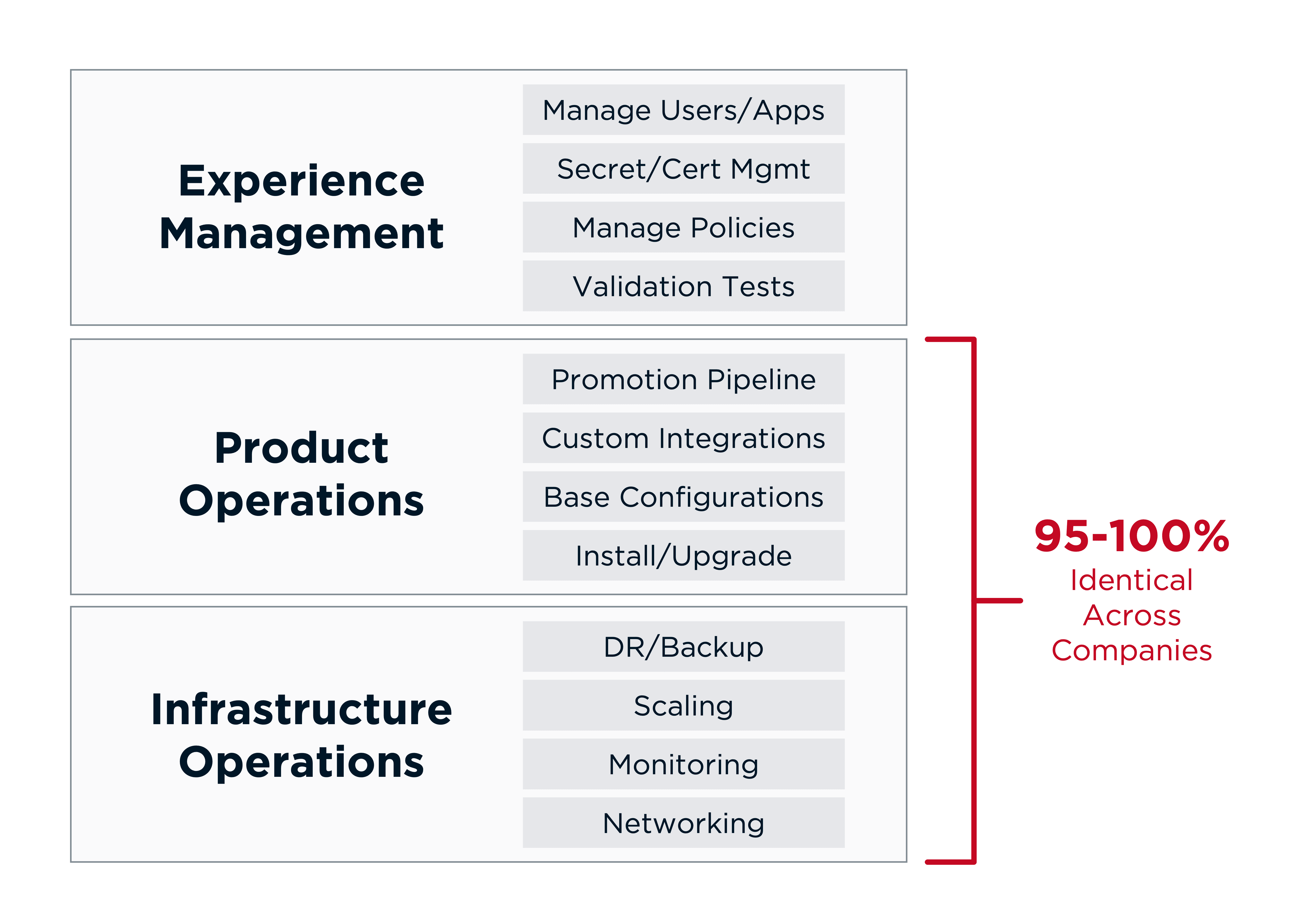
When you think of running software on-prem, you have someone who manages your Infrastructure, your CPU, your networking, your backups, and all of those standard stuff.
Somebody who understands what to do when there is a production alarm, When there are issues with one of your notes, somebody to jump in in the middle of the night and address those production issues.
And finally, somebody who does your administration configuration.
Uh, we call it Experience Management.
These are the folks who are designing what the User flows need to be.
As you look at the enterprises, this top layer is very unique to each enterprise.
Your enterprise is way different than anyone else.
But this bottom two layers, 95 to 100% of the steps that every enterprise does is identical To anyone else running the same capability.
Same set of CPU monitors, alarming on networking issues.
On uh memory, disk space, and so on.
Alarms for what happens when a pink footnote has an issue.
And most of my customers call out that this bottom two layers uh consume about 40 to 60% of their resource bandwidth.
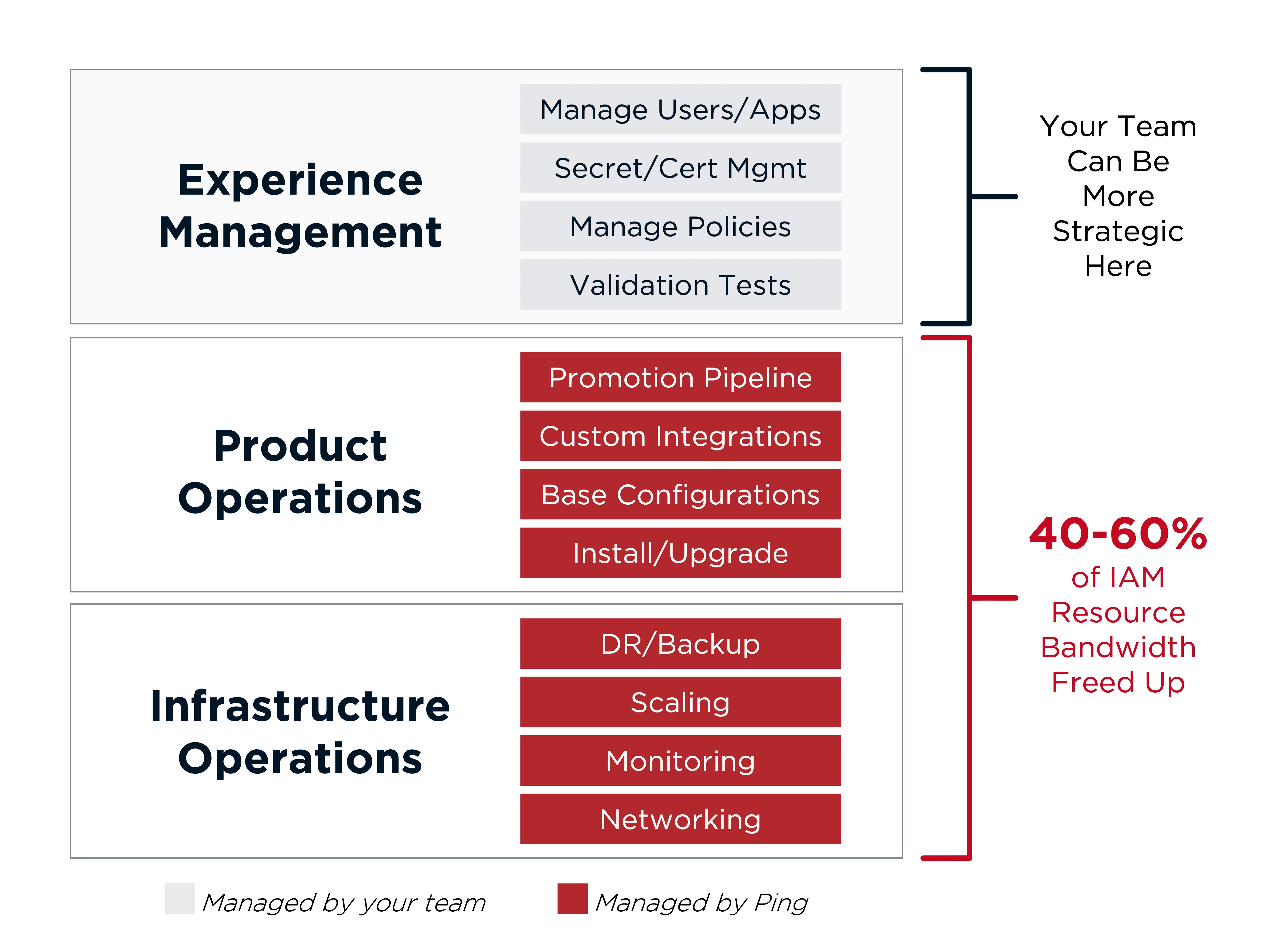
Now when you move to Ping's cloud, Ping owns the responsibility and accountability for those Two areas.
And that translates into two key benefits for Our enterprise customers.
One, we are going to bring in all of the best practices that thousands of our customers have Used in the past, that's all pre-built into the product.
And secondly, it is all automated, so the cost of operation is much lower when you consume it As a cloud service from us, compared to somebody having to build everything from Scratch.
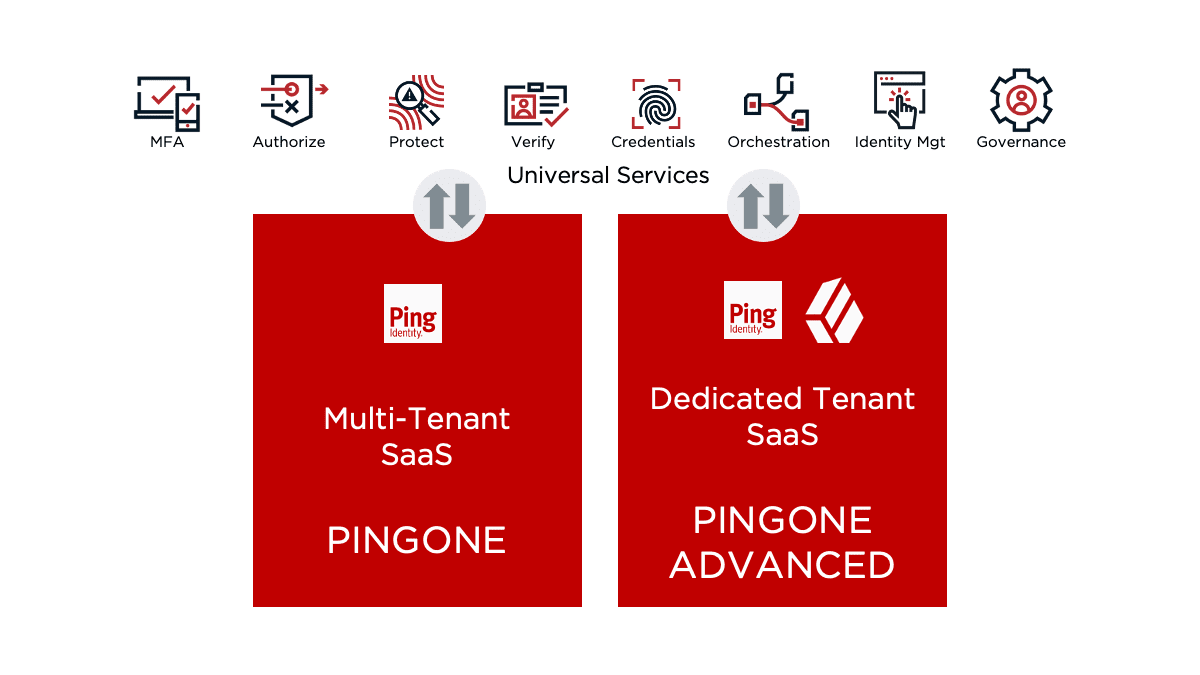
When you think of it from, um, under the covers, How is the architecture put together, as you are familiar with, Ping has always been providing in-depth capabilities, highly cohesive, Loosely coupled.
So we're not going to mandate that you are To buy uh Authentication and Directory from us, but if you buy both from us, You do get 1 + 1 equals to 5 type response because there is some pre-wiring that allows You to do sophisticated use case.
These are all orchestrated with our DaVinci engine, and you administer either using Our Admin-UI portal or APIs.
For today's focus, we're going to talk about this area, The advanced Services piece, which has this border both as a red and blue.
All the red ones imply a cloud service, and the blue one implies you could run it as an On-prem software.
So, the advanced Services components, these are the ones that we have consumed as a software in The past.
Now you can consume it as a cloud service from Us.
The advanced services components are provided As a dedicated tenant, so no noisy neighbor, uh issues for you.
It is built with auto-scaling and auto-healing.
We don't ever do TPS throttling.
Some of our competition does.
And one of the prospects was sharing, uh, that their API usage spiked.
And uh this competitor sent them a $4 million bill.
With Ping's case, you would never have those kinds of surprises or no impact to your Operations.
With regards to administration, you have a Centralized Admin UI portal to come in for all of our PingOne Advanced Services capabilities.
It is the same portal that you're familiar with when you're running it as an on-premises or so you Don't need to learn any new technologies.
From alarming and monitoring perspective, we have a lot of in-depth detailed alarms and monitors.
But on top of it, large enterprises do say that They want to have visibility into what is going on.
So in those cases, uh, we have options for our customers to be able to subscribe to these Log files, feed them through your SIEM tool for all of your stock operations and more Monitoring that you would like to have.
We also have, uh, options for customers to subscribe to our SMS alarming.
Knowing fully that, uh, that is for visibility, we are accountable for fixing it.
Apart from that, we also provide you Grafana and Kibana dashboards, which gives you a lot of in-depth details on how the platform is operating.
And with regards to the network integration options, we provide you three different Patterns.
For customers who want to consume this as a Cloud service, come to our Login Portal or access our Admin-UI portal for configuration, Call our Authentication APIs or Admin APIs.
You don't need to build anything unique or special here.
It is all over the internet.
So it is, it's a full cloud service with no additional requirement there.
For customers who want to do UM held up endpoint.
On advanced Services.
In those cases, we would put a simple network which is a VPN, uh, to allow you to access the LDAP endpoint.
And for customers who have needs for supporting UDP-based protocols, Kerberos or RADIUS, in those cases, uh, we recommend, we offer a Most sophisticated advanced networking option where we act as an extension to your On-prem footprint or where, wherever your corporate environment resides.
And there's advanced networking option, we would work with you in, uh, putting a dedicated A VPN network connection between your infrastructure and the cloud service.
We request IP ranges from you, so it is visible to you guys.
Uh, and it comes with a lot of additional protection, uh, to support this UDP-based Protocol.
From an environment perspective, by default, You get a sandbox dev instance and a production instance.
Dev is going to be a small two-node instance where your developers can quickly configure it, Validate that it is working.
And production comes with sizing required to support your full production volume.
It can run in as many regions, geos with as many nodes that is required.
For customers who have needs for stand-alone QA, you can, uh, additionally, Optionally buy a test environment.
And if you are in the process of doing regular load and performance testing, You can buy a stage environment which mimics and is identical to production with regards to The same number of geos, regions, and nodes.
Talking about UH Geos and region, we, this is a global service.
It is offered across the globe, and each of the geos that are represented here in North America, EMENU APAC, all of these have at least 2 regions' operational limit.
Uh, so with regards to AIPAC, we operate in Singapore and Sydney.
For India, we operate in, in uh Portland, OR I'm sorry, In Ireland, and in Frankfurt for North America, we operate in Ohio and Portland.
For the US region, and in Montreal for the Canadian region.
We understand that the global landscape and the regulations around data residency are continuing to evolve.
So we allow for customers based on your Businesses need to either consume it all as clustered across all of the geos, Uh, three regions clustered together.
So, no matter where your customers come From, they have the same low latency and fast response time.
Or if you have those data residency needs, and you need data in Europe to remain only there Europe region as compared to the US region, you could run a multi-region clustered In each of these GEO as independent solutions.
So, that's uh providing you options to meet your global residency needs.
Now moving on to the roadblocks that most customers, uh, share with me as they think about My, uh, their journey to the cloud.
The first one is migration risk.
Uh, for most of our Ping On-Prem customers, um, things are working well.
They like the configuration.
Uh, yes, there is a desire to move to the cloud, but, uh, Do I want to touch something that is working or How risky is it for me to move to the cloud?
That's the first question they go through.
Secondly, they talk about, um, how do I staff and fund this migration.
And third, uh, item is with regards to, uh, is there gonna be a loss of functionality when I Go from on-prem to cloud?

With regards to migration risk, Ping has proven ways of migrating our on-premises customers to Cloud.
You can choose one of these two patterns.
Um, you can choose to migrate in a flash cutover.
You take everything that is running on-prem, bring it to the cloud, Uh, repoint your APPs to the cloud service.
Or you can do it in a phased migration where you're bringing in a bunch of APPs at a time.
So that there are, you, allows you an opportunity to even reactivate or use some of The newer options of providing services to your application.
Now, in case of a flash cutover, if your implementation is primarily out-of-box being Fed usage, it could be as simple as these 5 steps.
We build your advanced services environment.
We would export your configuration from on-premises.
And no matter what version you're running from, so we can, We take that and run it through our upgrade factory to match it to the version that is in Advanced services.
Upload it into cloud, Repoint your DNS, remove the connection to on-premises.
It could be as simple as that.
Again, our professional services team would help you as you embark on this journey in uh Vetting your current instance and identifying the optimum path to migrate you to the cloud.
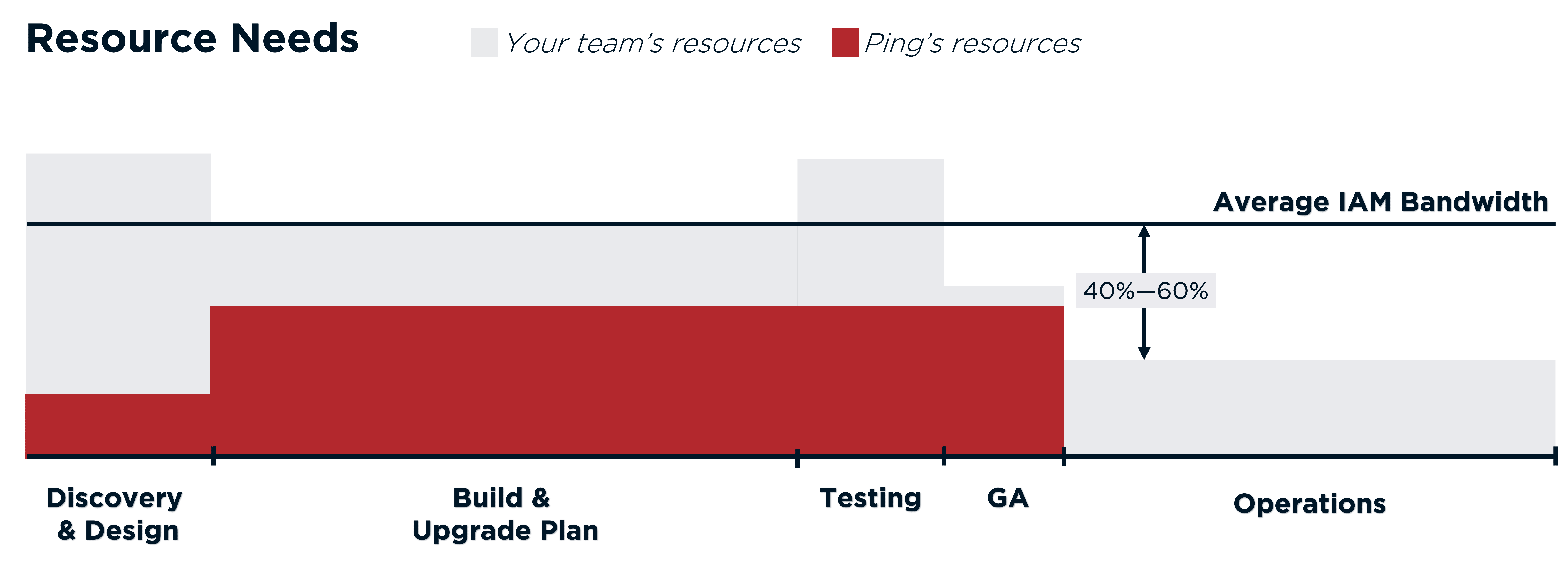
With regard to cost and resource prioritization, a typical migration project Would look something like this.
If this black line refers to your average IAM bandwidth on a day-to-day basis for you to Operate the platform, uh, the initial discovery and design state, Uh, we would need your resources to be involved a little bit more on top of their to provide RPS Team, Professional Services Team.
With information on how we're creating our platform.
Uh, during the build and migration phase, our team would be doing the heavy lifting and doing or migrating into the Cloud.
Uh, your team needs to be, um, focused on, re-engaged and focused on during the testing Phase.
Actually, your team is going to be engaged Throughout.
Uh, but during the testing phase, They do need to, uh, spend some time and bandwidth in, Uh, validating everything is working according to your need.
And during the migration, uh, our team would do the bulk of work, and you would start seeing Your team's operational maintenance time activity coming down.
And post-migration, your team's bandwidth, about 40 to 60% of your team's bandwidth would Free up, that will allow you to accelerate some of your other digital transformation Projects.
With regards to the funding model.
Um, these are the actual numbers of one of my customers.
This might be different from how it would manifest for you.
But this gives you an idea of how it all plays out for our customers.
As you look at it, um, When you move to cloud, there is an additional price from paying uh because it's going to be a cloud service.
Uh, from your side, you would get 3 benefits.
The first one, You don't need to pay for hardware infrastructure to run the service.
So that is an immediate saving you'd get.
The second one, your resource bandwidth is no longer going to be consumed in the maintenance and operation layers, the bottom two layers in the stack that I shared before.
That is going to be an additional saving.
And the 3rd 1 is the value to the business for accelerating bringing on new applications or Adding new IAM capability into your platform.
So that's another component of your business.
Value.
So as we look at it, most customers, uh, Get their payback period of 6 to 10 months.
So that is, uh, the additional price that you pay for a cloud service.
Uh, uh, versus the savings that you get within 10 months, You're break-even at that point.
And then when you look at it in a 3-year period, what is your return on investment?
Uh, typically, we see 200 to 300% return on investment.
Uh, so, an example would be if your investment is about 500 and, Uh, consuming it as a cloud service from us, in a 2, In a 3-year model, you're looking at a million to 1.5 million of total cost of ownership savings.
And moving on to the last roadblock, uh, item, which is loss of functionality.
When you think of uh on-premises software capability, you do have full control and uh deepest capabilities.
But you do need to build people and teams to address every layer of their operations.
So, it is one of the most expensive solutions and uh with the timelines of how fast you're Able to bring on your infrastructure, etc., It's also the slowest time to value.
On the other end of the spectrum, the standard cloud-only, uh, Cloud providers would come and say, oh, that is easy, we'll give it in Cloud.
Some cases, they're lower cost, um, but because it is cloud, It is faster time for you to.
Move to your production.
But the trade-off is that you lose a depth of capability and control.
This manifests as a mandate saying if you're using your Authentication, You need to move all of your data into the cloud.
It doesn't support full Federation Hub.
Uh, it has limitations on number of IdPs or Types of IdPs and so on and so forth.
When you come to a Ping's Club.
It is the same capabilities that are, you're running on-prem, You're consuming it as a cloud service, so you get the best of both worlds, Fast and capable.
So you're not having to do this hard trade-off, but get the benefit of cloud without losing the Sophisticated functionality that you come to pay for.
So that's setting the stage with that, let me transfer over to Davis to share Honeywell's Journey to cloud.
Mhm.
Great, Joseph.
Thank you so much.
Um, yeah, so, I mean, first, let me start by saying, uh, So my name is David Farra and I work for Honeywell.
I'm actually the throat to choke for Identity for the, Uh, for the enterprise, um, and I'm part of the Honeywell Global Security team.
Um, just a little bit about Honeywell before we get started on the topic at hand, Right?
Honeywell is a Fortune 100 company.
We have very distinct businesses.
Um, and I'll just give you a few cool facts about Honeywell.
Um, our aerospace business has components in 80% of the satellites in orbit today.
We provide navigation solutions for 90% of commercial air transportation and probably About 70% of military aircraft as well.
Uh, we have another business called Honeywell Building Technologies, And they provide products, software, services to over 10 million buildings across the world.
Um, another business, uh, our performance materials and technology.
This business and specifically the division called Annual Process Solutions is responsible For generation, transmission, and distribution of energy to over 160 million homes, Buildings, and commercial industrial facilities around the world.
We also have our safety product solutions, which provide about 50% of the US hospitals with data capture technology to ensure that patients get the right medicine dosages.
So, um, if you think about those businesses and you think about the service that I provide, Um, all of the above actually leverage my service to some degree or another.
And specifically, um, they use the SSO service for authentication and authorization.
Um, and this is for the workforce as well as, uh, customer revenue-generating APPs, And we have approximately 1,000 applications that are now being integrated with the, Uh, in Cloud Service that uh Joseph was talking about.
Now, on the topic at hand, um, yeah, if we can jump to the next slide, Are we correct?
Um, so some of the fundamental reasons for Moving to the cloud, um, I think we had, uh, the ability to forego, You know, constantly having to manage bug fixes and support, Uh, of new functionality, as well as just the overall maintenance and, Uh, resource constraints we had on the in-depth knowledge that, Uh, our SSO team had to have, uh, to keep the on-prem service alive, Available, and meeting the demands of the stakeholders.
I think additionally there was an ever-evolving need to implement multi-factor authentication As it became more and more prominent within not only the industry but from a security posture, Kind of making sure that we're protected effectively, and we realized very quickly that Having a less than adaptive risk-based multi-factor experience for our users wasn't Going to appeal to the masses, especially with the different personas that we had.
And so leveraging uh Ping and Ping Advanced Services as well as PingOne MFA and PingOne Risk Really gave us those, um, really seamless and, and, and really great user experiences.
I think another extremely important driver that we had, Uh, especially at the leadership level, at the C-suite level, Was the resilience, redundancy, and availability that we get from moving to the Cloud, allowing us to confidently say that we could support customers with a 4 9s Availability.
Which was being demanded by our business.
Stakeholders for at least all of our revenue generating applications and services.
So that, that was a huge win on our side.
Um, now, um, we have had some trials and tribulations getting the right design in place To achieve, you know, the high availability, um, but the PE team did step up and partner with Use effectively to get the right resilient solution.
Uh, once we managed to get that, our next challenge, um, Was all around standardization of integration, right?
We've had so many legacy, uh, applications have been integrated with old protocols, Yes, like OpenToken, bad, bad, bad, um, but we managed to, To rise to the occasion.
Um, we partnered with all our APP teams, Uh, within each of the different businesses as well as Enterprise IT.
Um, with a significant amount of training and streamlining our intake, Uh, forms for the migration, and we also provided, we got to the extent where we Provided standard code patterns because we wanted application owners to really.
Understand that if they leverage these standard code patterns, Um, one, they'll have a modern integration capability, as well as the fact that moving to The cloud is going to give that higher availability, redundancy, and availability, and they no longer have to worry about things like, um, adaptive, Sorry, adaptive risk-based MFA.
Um, we took a phased approach to the migration.
Um, we were able to spin up and spin down different levels of support, Uh, with migration, sorry, for the migrations with our application teams, Just depending on their expertise or a support model that, that they had in place, that's been working well.
Um, we also put in place an enterprise, uh, wide request to integrate with the SSO service Every time a new application comes in, Honeywell, uh, is being leveraged by, um, by, by the enterprise or by, by customers.
Um, now, our current state, we're approximately 80% complete on this journey with an aggressive and published goal to deprecate the On-prem SSO service by mid next month.
So, we're almost there, um.
And uh I think back over to you, you have, or Joseph, or any questions.
Thank you.
Yeah, thanks, Davis.
I appreciate that, that overview, and we do have a couple of questions for you.
Uh, first one is, um, so I think in terms of drivers, a lot of, Um, a lot of customers that we hear either have a cloud mandate or there's a need for digital Transformation, or there's, uh, kind of an Opportunity to unify, Uh, you know, SSO across the organization.
What were some of those primary drivers for you?
At Honeywell?
I, I, I think, uh, overall centralizing Identity services across the organization is huge.
We're constantly driving that, but of course, um, SSO specifically, Um, in layman's terms, just gives that unified experience that you just talked about.
Right?
The ability for people to log in with the Same experience that's known to them, they understand what's coming next, Um, getting the ability to move towards a passwordless experience is also big.
And then, of course, from a security perspective, we wanted a unified experience.
Again, that adaptive multi-factor experience, um with respect to MFA so that we're Stepping up, uh, appropriately.
Um, I think the other one that was really, really big for us was that reliability of service and the availability and the re uh sorry, resiliency and redundancy.
Especially with the multi-region design that that Ping has to offer, We were able to, again, go back to the businesses, go back to the enterprise and say, Hey, look, I know you're leveraging, you know, the Central Identity for authentication, But now we can provide, um, you know, the right confidence for that 4 nines worth of Availability, which is great.
Mhm.
Got you.
And that's good to hear.
And we did have another question come in.
I think it is, uh, you were describing kind of the size of Honeywell and the various businesses that you have.
Uh, so the, the question was how many transactions are, Is Honeywell processing through, um, through PingOne Advanced Services per month on average, If you have a ballpark.
You know what, I, I, I couldn't tell you off the top of my head.
We've got, uh, 650 or so, the most, no, I'm sorry, the numbers this morning were more Like 750 applications, critical applications that have been integrated to date.
Some are workforce, some are revenue-generating customer APPs, But I'd have to go double-check on the transactions front.
And I can do that.
No, it's good to hear.
Yeah, I can give a perspective of another customer of ours.
Um.
Vizio uses advanced services for their Authentication and, uh, to understand the scale that the platform can offer.
Their average is about 35,000 transactions per minute.
During Super Bowl and Olympics, it's shot up by 100x to 3.5 million Transactions per minute, and the system was able to auto scale and address it.
No one in Ping was waking up saying, oh my goodness, I need to add additional CPUs, Additional memory.
The system does it, of course.
We were monitoring it too.
So that gives you an idea of scale.
Another aircraft manufacturer is looking at consuming 80 billion transactions per day Through the platform.
So from a scale perspective, There are a lot of options there.
And I'm pretty sure when Davis gets the number, it's gonna be a big number for Honeywell too.
And continually growing for that matter, right.
All right, um, another question, I think Joseph, this one might be more for you.
So for a company that's just starting with Ping, not yet in production, Do you recommend going to the Cloud directly?
I'm assuming it might be, depends, but.
Uh, there are, uh, for most cases, moving to the cloud, Uh, immediately allows you not to have to stand up your own infrastructure, Build your own teams, to understand all those layers, use short circuit all of those, And get to a place where you get the sophisticated capabilities without having to Worry about operations.
And there are a number of customers of ours that come directly into Cloud.
Gotcha.
Uh, this next one came in, probably also for you, Joseph.
Do you host LDAP with password hash in the cloud?
Yes, we do.
Um, our For those of you who are familiar with Our PingDirectory offering that is available as part of Advanced Services.
Out of the box, it comes with a number of hash models, and um I think we, We can provide you those lists offline, and it can, uh, come with a scale that you would need to Operate at millions of records with response time in milliseconds.
Uh, two-digit milliseconds.
Mhm.
And another one for you, Joseph, I think, how quickly do you autoscale?
Do you need to see prolonged lower or higher usage to auto-scale?
Uh, so the way we would set it up is, again, because this is a dedicated tenant for each Enterprise customer.
So, for, in Honeywell's case, We would work with the UM customer to identify what is your average load.
And the base infra, uh, base solution that is implemented is going to be able to handle Upwards of 125% of your peak, not your average of your peak.
And then as you hit past that level, and we're talking in terms of minutes when you're Load goes past the level, uh, for a handful of minutes, 3 to 5 minutes, Then it, uh, starts spinning up nodes to provide you all scaling.
And for whatever reason, if there is a big um Activity going to happen in your environment And you expect this to shoot up like you're having a, You're in retail space, and it is, uh, Black Friday, so you want to scale up.
We can work with you even um spinning up additional notes.
You don't need to wait for the load to trigger the scaling.
We can do it manually, too.
Mhm.
Thanks, Joseph.
And this next question, Probably a little bit of, of, of, of both one for part for Joseph, Partly for Davis.
It's saying, is there a case study you Can cite or share when the, where an existing on-print PingFederate customer moves to the Cloud, uh, and, you know, solves the issues, concerns, um.
And one of the issues, issues, concerns that they were able to solve.
It sounds like Honeywell went straight to the cloud from not using Ping unless I Misunderstood.
Yeah, yeah, yeah.
We started out, in fact, we've, we've had uh PingFed in place for, For probably a decade.
Um, so we've, uh, decided last year, Late last year, uh, that we would move to the cloud.
So this is actually in fact a huge, huge jump for us.
And, uh, again, part of that driver was the fact that, Uh, we were leveraging our on-prem global data centers, um, And so we decided that we wanted to get out of the business of hosting, Um, such a critical service, and so we took that phased approach, Um, we very quickly.
I, I would say in a matter of almost 90 days, it got the environment up and ready for Production; starting January 1st, we ended up starting, we stopped any on-prem integrations At that point, and we moved to any new application that's onboarding into the cloud And then since we've migrated again approximately 700, 750 applications that were previously leveraging the on-premises service.
Mhm.
And then Joseph, if you have any comments, I, I, as I'd imagine there's a kind of a nice mix between existing customers migrating to Cloud or, you know, net new prospects coming, you know, and just going straight to cloud.
I'm sure it kind of depends on.
Yeah, um, I would say from a migration perspective, we're about 30 to 50% of The existing advanced services customers were those who moved from on-prem footprint to the Cloud.
So that does leave you remaining as new.
Customers coming in.
And these are not necessarily new to Ping.
They are coming in and they're like, hey, I'm using your MFA.
I want my authentication and Directory all in cloud, and that one they spin up a brand new, Uh, from scratch in our Advanced Services capabilities.
So based on your business needs, we would work with you to identify the best path forward.
In most cases, if you're looking to move to cloud and you don't have any on-prem footprint, You can come directly to the cloud without having to go through an on-premises step.
Mhm.
Gotcha.
All right, here's another question.
How's the operating model?
Is this tenant-based versus segregated cloud?
So Karti again, I might require some more, uh context around the question.
Um, uh, for each customer, they have their own dedicated tenant.
And within the tenant, um, you have those environments, and we make sure that all of those Are up and running.
You can choose to buy a tenant with only operating in a single region or multi-region Cluster together.
If you want it, uh, for data residency needs, You want it as a segregated tenant, um tenants, then you would have in each of the regions or Each of the geos has its own independent tenants.
End of the day, from an Enterprise customer perspective, you would have to worry about what Are the services that you need.
Do you need an application, Federation Service, Directory Service, Access Management.
And you tell us from a requirements perspective Or is there, Are there any data residency needs or localization needs, And we would recommend to you what is the best uh footprint for supporting your need.
Thanks, Joseph and Davis, we've got one question for you.
So, I, this one's kind of about benefits that you've noticed from the cloud migration.
I think you mentioned they're about 80%.
Of the, Of the weight there, and you, uh, mentioned adaptive authentication, Adding some risk, and, uh, and like a consistent MFA kind of, uh, Kind of service.
So, are there any other kinds of benefits or Things you've noticed or able to, uh, to share?
Uh, I think again, it really boils back to the fact that we have now, Uh, a confirmed high availability that we can depend on.
I think from an end-user perspective, they're finding that the new service, Although it's slightly different in terms of look and feel, They find that it, it, uh, it seems to work a lot better because, again, They're not being prompted by MFA every single time, all the time.
And so they appreciate that aspect of it.
They're also seeing the benefits because we're also implementing things like Windows Hello Business.
And so we've integrated our in-Cloud SSO Service for web applications with Windows Health for Business.
And so from their perspective they're getting a real seamless identity authentication Experience.
So that's what we noticed.
I think the next.
The evolution of this is that we've all been talking about Zero Trust, And we all talk about Zero Trust with specific technologies and ecosystems, But how do we now cross-connect everything, right?
And so, um, I, I've taken another step where we're starting to, Um, to leverage DaVinci for that purpose.
And so we're gonna move towards, you know, leveraging PingOne DaVinci to be that connector, That orchestration layer for us, and we're also gonna become, I mentioned, the throat to choke for Identity, but I also want to become the throat to choke For Zero Trust in general, right?
Because I find that Zero Trust is gonna become a lifestyle, And so you're gonna need to be able to effectively manage.
How you deal with, you know, device validation, network validation, User validation continuously.
And so, again, my next step is to use DaVinci on that.
Got it.
Thanks, Davis.
Thanks for sharing that.
That was my other follow-up, and in terms of Next steps and so, like you're, you're right on it.
Got a combo answer right there, so thank you.
Couple other questions.
I think Joseph, these are similar long topics.
Um, uh, we use PingFederate as a service provider in our environment, Mostly SAML connections with reference ID adapter.
How does the cloud migration work?
So, yeah, it is like what I explained a few slides ago.
Um, our PS team would vet your existing infrastructure to identify if there are any NSI cases If you're just doing SAML 2.0 only, then it is as simple as remote doing a data.zip export.
Um, if you're in an older version of Ping Fed, we'll run it through our Upgrade Factory, Upload it into the cloud environment and repoint your DNA.
So it could be as simple as that.
If there is any uniqueness to your footprint with regard to like NSI non-standard Integration kits that you have procured from us, uh, we would make sure that those are also Available in your Advanced Services cloud, footprint.
And our, there are additional requirements that need to be built, Uh, we can build it out.
For those of you who have experience with Ping Fed, it's a Swiss Army knife.
You could do almost everything that you need on the Identity Authentication, Global Authentication Authority with FedRAMP You would be able to consume that as a cloud service.
Mhm.
Thanks, Joseph.
And one similar topic, can we convert our on-premises licensing to a cloud solution?
Absolutely, uh, it is a different entitlement, uh, but for customers who are coming from our On-prem to cloud, we're not going to ask you to double pay.
We'll work with you regarding the migration window, How long you need your on-prem to exist before you're fully cut over to a cloud service.
And we, we can look at options of, um, converting those licenses over into cloud.
Mhm.
Cool.
Sounds good.
Um, not seeing any other questions in the chat or the Q&A box, So, um, I think we can probably kind of start wrapping this up.
And then Joseph, if you wouldn't mind just advance to the next couple of slides I have Like 11 exit one, yeah, thank you, everyone.
Thank you for joining.
Davis, really appreciate your time.
Thanks for sharing your, Your customer story.
Um, yeah, they're really insightful, Joseph, As always, thanks for the overview.
In terms of what's next, we're kind of, we're continuing topics that we, We get from our existing customers.
I think in the past, We talked about getting more out of.
Of being federated, Uh, how to enhance your, uh, accelerate your password list deployments, Uh, the next couple of topics this year, uh, is gonna be all about enabling risk and fraud Signals, more like a fraud solution, and also, Uh, consolidating your workforce in SIM, Uh, use cases onto a single platform.
Uh, one last note, uh, Ping Insider Network, it's a, If you, if you, if you see some emails about it, feel free to join.
It's where you can kind of participate, uh, read some blogs, Get rewards, and redeem them for various prizes, whether it's Ping swag, or any gift cards or any kind of donations.
And that's a wrap.
Thank you all.
Thank you again, Davis, and thank you, Joe, uh, Joseph.
Appreciate the time.
Thank you.
Take care.
Take care.
Bye.